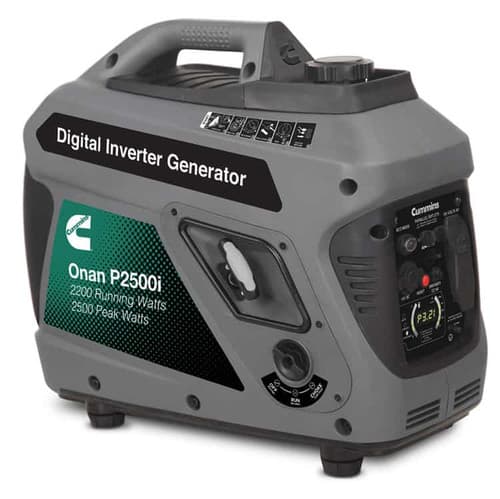
Onan (Cummins) Generators
Cummins residential power since 1920 — the RS series dominates home standby, commercial sets scale to 3,750 kW
Why buyers choose Onan
- 100+ year heritage — Onan founded 1920, acquired by Cummins 1986, residential brand recognition remains strong
- RS Series dominance — the RS20 is one of the best-selling residential standby generators in North America
- Quieter than Generac — RS units run 65-67 dB vs Generac's 66-72 dB range
- Full Cummins backing — commercial sets use QSB/QSK engines with 500+ service locations
Who Onan is for
Residential standby (13-30 kW) where brand trust and quiet operation matter, plus commercial applications inheriting Cummins' full engine lineup.
What to consider before specifying Onan
- Brand confusion — buyers unsure if 'Onan' or 'Cummins' when shopping
- Fewer residential installers than Generac's 10,000+ network
- 10-20% price premium over Generac for comparable residential units
Onan is one of the oldest names in portable and standby power, founded in 1920 and acquired by Cummins in 1986. The brand survives today on residential standby generators (RS series, 13-30 kW) and RV generators (QG and QD series, 2.8-12 kW), where name recognition and dealer loyalty remain strong. Every Onan unit sold today is engineered and supported by Cummins Power Generation.
For commercial and industrial applications above 60 kW, Cummins drops the Onan name entirely. The commercial lineup uses Cummins' own engine platforms — QSB (4.5-6.7L), QSL (8.9L), QSX (15L), and the massive QSK series up to 95 liters — covering everything from small office buildings to utility-scale prime power. These are among the most widely installed commercial generators in North America, backed by over 500 Cummins service locations.
The practical difference for buyers: Onan-branded residential units compete head-to-head with Generac and Kohler in the 13-30 kW home standby market. They run quieter than Generac, cost less than Kohler, and benefit from Cummins' parts depth. The trade-off is fewer residential installers compared to Generac's massive contractor network. For commercial applications, Cummins generators are a default specification alongside Cat and Kohler — choosing between them is usually about dealer relationships, parts standardization, and total cost of ownership over a 20-year lifecycle.
Frequently asked questions
- Is Onan the same as Cummins?
- Cummins acquired Onan in 1986 and gradually merged the product lines. Today, 'Onan' is used for residential standby (RS series) and RV generators (QG/QD series), while commercial and industrial sets are branded 'Cummins.' The engines, engineering, and dealer network are fully Cummins.
- What is the most popular Onan home standby generator?
- The RS20 (20 kW) is the best-selling residential model, covering most homes up to 4,000 sq ft on natural gas or LP. It uses a dedicated Cummins engine, runs at 3,600 RPM for compact packaging, and includes a 200-amp automatic transfer switch. The RS25 and RS30 step up for larger homes.
- How does Onan compare to Generac for home standby?
- Onan/Cummins RS units are typically 10-20% more expensive than equivalent Generac models but offer lower operating noise (65-67 dB vs Generac's 66-72 dB), better low-temperature starting, and access to Cummins' commercial-grade dealer network. Generac wins on upfront cost and wider installer availability.
Key specs at a glance
- Power range
- 20–2000 kW standby
- Fuel types
- diesel, natural-gas, lpg
- Engine OEMs
- Cummins
- Alternator OEMs
- Phase options
- 1-phase, 3-phase
- Models in library
- 5
Onan (Cummins) Product Families
onan
Cummins QSK Series (Industrial)
Cummins heavy industrial diesel generators — 500–3,750 kW on QSK V12/V16/V18 engines for data centers and critical infrastructure.
500–3750 kW
onan
Cummins QSB Series (Commercial)
Cummins mid-range commercial diesel generators — 60–200 kW on QSB 4.5L and 6.7L inline engines.
60–200 kW
onan
Cummins RS Series (Residential Standby)
Cummins residential standby generators — 13–30 kW on natural gas and LP with Onan heritage.
13–30 kW
Onan (Cummins) Units For Sale1
Application Engineering
Not sure if Onan (Cummins) is right for your project?
Our engineers spec across 14 brands and 600+ models — diesel, gaseous, portable, and prime power — with no single-brand obligation.
Need help with Onan?
Our application engineers help size, spec, and source backup power for commercial, industrial, and mission-critical sites.